The memory that wouldn't come back
• Craig
Recently, while working on Docker VMM, I was investigating memory usage when sharing a large folder with a VM over virtio-fs. The file-sharing server runs on the host.
After running find across the folder and dropping the guest’s caches, the host process was still holding more memory than before the walk.
Following the references
The guest’s /proc/meminfo showed that most of its cached file data and filesystem metadata had been cleared. But that only told me what was happening inside the guest. It didn’t tell me what the file-sharing server was still holding on the host.
I started logging the server’s inode table alongside process memory. This table maps the node IDs given to the guest to the file and directory state kept by the server. Entries were still there after the guest dropped its caches.
virtio-fs uses the FUSE protocol to pass filesystem requests between the guest and the server on the host. FUSE tracks lookup references to nodes: a count of how many references the guest holds to each one. The guest releases them through FORGET requests, allowing the server to free its state once nothing else needs it.
The bug was in our handling of READDIRPLUS. This returns directory entries with their attributes and adds a lookup reference for each returned entry, except . and ...
Our implementation looked up more entries than would fit in the reply. The reply builder discarded the overflow, but didn’t undo those references. Later requests could look up the same entries again.
The guest couldn’t release references it had never been told about. That’s what kept the host state alive.
Only look up what fits
The fix was to check whether each entry would fit in the reply before looking it up, using the same size calculation as the reply builder.
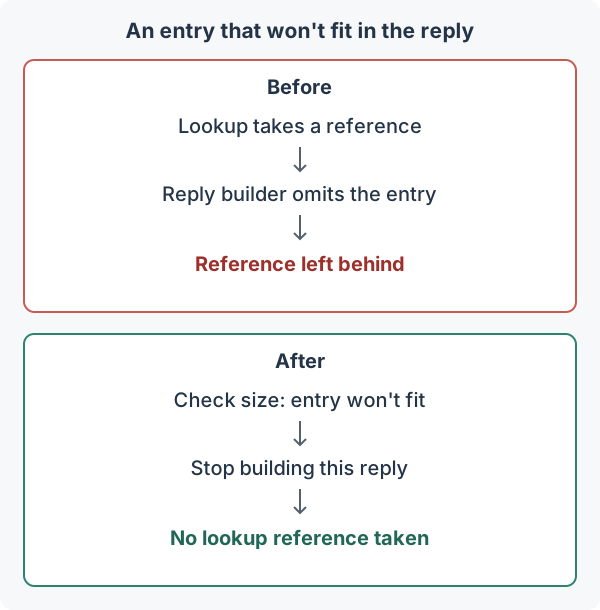
With that change, the inode table drained after the guest released its references. The server was no longer holding lookup references for entries it hadn’t sent.
I’d spent time looking at the guest’s memory, but the useful clue was in the server’s inode table. Once I could see which entries weren’t going away, I had somewhere to look.